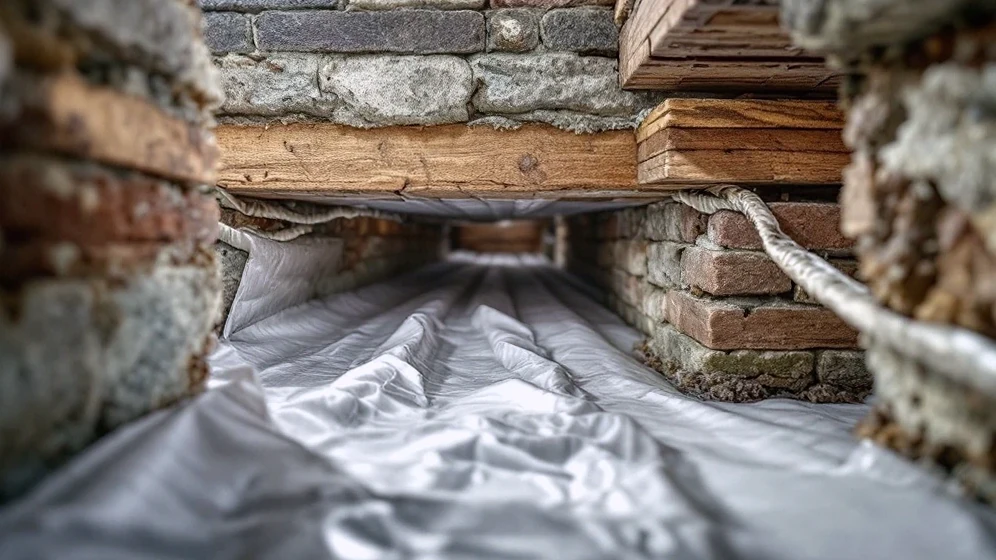
What is Crawl Space Vapor Barrier Installation and how does it work?
Crawl space vapor barrier installation is the process of covering the bare dirt floor of your crawl space with a heavy plastic liner, sealing the seams and edges to the foundation walls, and often connecting it to a radon vent pipe. It stops ground moisture from rising into the house and gives radon a path to the outdoors instead of your living room.
If you have a crawl space, you have bare dirt under your floor. That dirt is always releasing water vapor. In a Huntsville summer, when the air is already thick, that vapor rises into the crawl space, condenses on the cool wood joists and subfloor, and keeps the whole underside of your house damp. A vapor barrier puts a stop to that. It is a thick polyethylene sheet, usually 6 to 20 mil, laid over the entire dirt floor, lapped at the seams, and sealed to the walls with a termination bar or construction adhesive. The edges get sealed because moisture will find any gap you leave.
For radon, the barrier does double duty. Radon is a radioactive gas that comes from uranium in the soil. It moves up through the dirt and into your crawl space, then into the house through gaps around pipes and cracks in the floor above. A sealed barrier traps that gas below the plastic. We then run a PVC pipe from under the barrier up through the roof, with a fan that pulls the gas out before it can enter your home. That is a radon mitigation system, and the vapor barrier is its foundation.
Costs for this work in Huntsville run $1,500 to $4,000 for a standard vapor barrier installation. (huntsvillecrawlspaces.com) A full encapsulation, which adds wall insulation, a dehumidifier, and sometimes a sump pump, runs $5,500 to $15,000. (huntsvillecrawlspaces.com) The difference is whether you are just sealing the floor or turning the crawl space into a dry, conditioned part of the building envelope.
- Barrier material: 6 mil is the minimum for a simple vapor barrier; 10 to 20 mil reinforced liner is better for encapsulation and foot traffic.
- Seams: overlapped at least 12 inches and sealed with a compatible tape or adhesive.
- Wall attachment: mechanically fastened with termination bars or adhesive, then sealed.
- Penetrations: pipes, piers, and posts get wrapped and sealed so no soil is exposed.
- Radon vent: a perforated pipe or gravel channel under the barrier connects to a riser pipe that exits above the roofline.
Short version
- A vapor barrier covers the dirt floor and seals to the walls.
- It blocks moisture and radon from entering the living space.
- For radon, it works with a vent pipe and fan to pull gas outside.
- Typical cost in Huntsville: $1,500 to $4,000. (huntsvillecrawlspaces.com)
How Crawl Space Vapor Barrier Installation works, start to finish
The job starts with clearing the crawl space of debris and old plastic, then grading the soil, laying and sealing the liner, and connecting it to a radon vent if needed. A typical install takes one to two days for a basic barrier, or three to five days for a full encapsulation with a dehumidifier.
We start by inspecting the crawl space. We look for standing water, pest damage, failing piers, and any existing vapor barrier that has seen better days. Old plastic gets hauled out. If there is any asbestos or mold, we handle that first. Then we grade the dirt so water drains away from the foundation and not toward it. In Huntsville, where we get heavy spring rains and red clay soil, proper grading is the difference between a dry crawl space and a swamp.
Next comes the liner. We roll out the polyethylene across the floor, cutting around piers and pipes. Every seam gets overlapped and sealed with tape made for the material. We run the liner up the foundation walls and fasten it with termination bars, then seal the top edge. For radon systems, we lay a perforated pipe or a gravel bed under the liner before we cover it. That pipe connects to a PVC riser that goes up through the roof. A radon fan pulls soil gas through the pipe and exhausts it outside, so it never enters the house.
After the barrier is sealed, we test the radon level again to confirm the system is working. If the crawl space will be encapsulated, we add rigid foam insulation to the walls, seal the vents, and install a dehumidifier to keep humidity under 55 percent year-round. (huntsvillecrawlspaces.com) That dehumidifier needs a condensate drain, either to a sump pump or outside. We also check that the barrier is tight around all penetrations. A gap the size of a pencil can let enough moisture through to cause problems.
- Clear and inspect.Remove old liner and debris. Check for water, pests, and structural issues.
- Grade the soil.Level the dirt and create a slight slope away from the foundation so water drains.
- Lay the liner.Roll out polyethylene, overlap seams by at least 12 inches, and seal with tape.
- Seal to walls and penetrations.Fasten the liner to the foundation walls and wrap pipes and piers so no soil is exposed.
- Install radon vent if needed.Place perforated pipe under the liner, connect to a PVC riser, and mount a fan outside.
- Test and verify.Run a radon test to confirm levels are below the EPA action level of 4 pCi/L.
Why Crawl Space Vapor Barrier Installation matters for your home
A vapor barrier protects your home from moisture damage and radon. Without it, ground moisture rots wood, grows mold, and makes your floors feel damp. Radon, a leading cause of lung cancer in non-smokers, can also seep in. Sealing the crawl space is the most effective way to address both problems at once.
Huntsville sits in a region where radon is common. The EPA maps much of north Alabama at moderate to high risk. You cannot see or smell radon, so the only way to know your level is to test. If your crawl space has no barrier, radon can move freely from the soil into your home. A sealed barrier, combined with a vent pipe, reduces radon levels by up to 99 percent in many cases. That is not a small improvement; it is the difference between a safe home and one that needs action.
Moisture is the other half of the equation. Damp crawl spaces breed mold, attract termites, and make your heating and cooling system work harder. In summer, humid air from the crawl space rises into the house and your air conditioner has to remove that extra moisture, which raises your power bill. In winter, the same moisture can condense on cold surfaces and cause rot. A vapor barrier stops that cycle. It also keeps your insulation dry, so it performs at its rated R-value.
A crawl space vapor barrier is not a permanent fix for everything. If you have active water intrusion from poor drainage, you need to fix that first. But for the majority of Huntsville homes with a dirt crawl space, a sealed barrier is the single most effective upgrade you can make. It costs a fraction of what you would pay to repair rotten floor joists or remove mold later.
- Radon reduction: a sealed barrier and vent system can lower radon levels by up to 99 percent.
- Moisture control: stops ground vapor from raising indoor humidity and causing condensation.
- Energy savings: keeps insulation dry and reduces the load on your HVAC system.
- Structural protection: prevents wood rot in joists, subfloor, and sill plates.
- Pest control: removes the damp environment that termites and cockroaches prefer.
A sealed vapor barrier is the foundation of any radon mitigation system in a crawl space home.
Common problems and what causes them
Most vapor barrier failures come from poor installation: seams that are not sealed, edges that pull away from the wall, or tears from foot traffic. Water pooling under the liner, usually from poor drainage, is another common issue. Radon levels can stay high if the vent pipe is not connected properly or if the fan fails.
We see a lot of DIY vapor barriers that use thin 6 mil plastic and duct tape. Duct tape does not stick to polyethylene, especially in a humid crawl space. Within a year, the seams are open and the barrier is useless. Another frequent mistake is not sealing the barrier to the walls. If the edges are just laid against the foundation, moisture wicks up the wall and into the wood above. We use termination bars and a bead of sealant to make that connection airtight.
Water under the liner is a sign of poor drainage. If the soil is not graded and there is no sump pump, water can collect under the plastic and create a pond. That water can eventually push the liner up or find its way to the surface. In Huntsville, where we get 50-plus inches of rain a year, drainage is not optional. We often install a sump pump and a drainage mat under the liner to manage groundwater.
Radon systems need maintenance too. The fan should run continuously. If it stops, radon can build up again. We install a manometer, a simple U-tube gauge, so you can see at a glance that the fan is pulling. If the fluid levels are even, the fan is not working. Also, the vent pipe must discharge above the roofline and away from windows. A pipe that ends at the foundation is worse than no system at all because it can dump radon right back into the house.
Minor tears or gaps
Small holes in the liner let moisture through. Patch them with compatible tape and sealant.
Standing water under the liner
Indicates a drainage problem. Need to regrade soil or install a sump pump.
Radon fan not running
If the manometer shows no pressure, the fan has failed. Radon levels can rise quickly. Call us for a replacement.
Frequently Asked Questions
How much does crawl space vapor barrier installation cost in Huntsville?
Most homeowners in Huntsville pay between $1,500 and $4,000 for a standard vapor barrier installation. (huntsvillecrawlspaces.com) If you need a full encapsulation with wall insulation and a dehumidifier, expect $5,500 to $15,000. (huntsvillecrawlspaces.com) The exact price depends on the size of your crawl space, how easy it is to access, and whether you need a radon mitigation system. We provide a free on-site quote so you know the number before we start.
How long does a vapor barrier last?
A properly installed 10 to 20 mil reinforced liner can last 20 years or more. The key is the installation. Seams must be sealed with the right tape, and the liner must be protected from foot traffic. If you use the crawl space for storage, we can add a protective layer or walkway. Thin 6 mil plastic is cheaper but tears easily and often needs replacement within a few years.
Can I install a vapor barrier myself?
You can, but it is hard work and easy to get wrong. The materials are not expensive, but the labor is. You need to move in tight spaces, cut around pipes and piers, and seal every seam. A poor installation can trap moisture or let radon through. If you are handy and have a helper, you can do it. But if you want it done right and warrantied, our crew handles it in a day or two.
Will a vapor barrier reduce radon levels?
Yes, if it is part of a radon mitigation system. The barrier alone blocks some radon, but the drop you are after comes when you connect it to a vent pipe and fan that pulls soil gas out from under the liner. That system can reduce radon levels by up to 99 percent. We test before and after to confirm the levels are below the EPA action level of 4 pCi/L.
Do I need a dehumidifier with a vapor barrier?
Not always. A vapor barrier stops moisture from coming up through the soil, but it does not remove moisture that enters from the air. If your crawl space has vents, humid outside air can still get in. In that case, a dehumidifier helps keep humidity under 55 percent year-round. (huntsvillecrawlspaces.com) If you encapsulate the space and seal the vents, a dehumidifier is usually recommended.
What is the difference between a vapor barrier and encapsulation?
A vapor barrier is just the liner on the floor and partway up the walls. Encapsulation is a complete system: the liner covers the floor and walls, vents are sealed, insulation is added, and a dehumidifier is installed. Encapsulation turns the crawl space into a semi-conditioned space. It costs more, but it provides better moisture control and energy savings.
How do I know if my crawl space needs a vapor barrier?
If you can see bare dirt, you need one. Other signs include musty odors in the house, high humidity, condensation on windows, and floors that feel damp. If you have a radon test result of 4 pCi/L or higher, a vapor barrier with a vent system is part of the fix. We can inspect your crawl space and test for radon to give you a clear answer.
Does a vapor barrier help with pests?
It helps by removing the damp environment that pests like. Termites and cockroaches thrive in moist wood and soil. A sealed barrier covers the soil and keeps the space drier, which makes it less inviting. It also makes it easier to spot pest activity because the floor is covered.
What kind of plastic is used for a crawl space vapor barrier?
We use polyethylene sheeting, usually 10 mil or 20 mil reinforced. The thicker the liner, the more durable it is. For radon systems, we use a liner that is rated for radon and can be sealed airtight. We do not use thin painter's plastic or drop cloths. Those tear and do not seal properly.
How soon can you install a vapor barrier?
We can usually schedule an installation within a week or two, depending on the season. Spring and summer are our busiest times because of heavy rains and high humidity. If you have a radon test scheduled, we can coordinate the installation and retest. Call us to get on the schedule.
Sources
Need radon mitigation in Huntsville? Get a free estimate today.
📞 256-567-5330