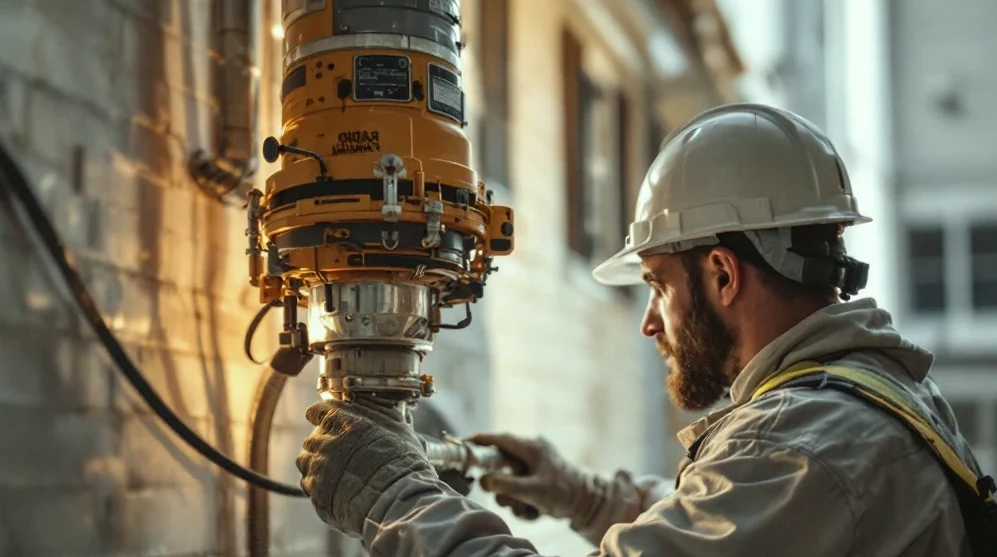
What is Radon Mitigation and how does it work?
Radon mitigation is a system that pulls soil gas from under your foundation and vents it above the roofline before it can enter the house. Once the fan is running, indoor levels typically fall within 24 to 48 hours, though the only way to confirm the drop is a follow-up test.
If your test came back at 4.0 pCi/L or higher, the EPA and the U.S. Surgeon General recommend fixing the home. (alabamapublichealth.gov) That number is the action level, not a ceiling. We see plenty of Huntsville homes in the 6 to 12 range, and a few over 20 in older houses with dirt crawlspaces or unsealed sump pits.
The fix is called active soil depressurization. A PVC pipe runs from a suction point under the slab or in the crawlspace, up through the house or along the exterior, and out above the eaves. A small inline fan pulls a vacuum on the soil, so radon travels through the pipe instead of seeping through cracks in the slab.
Most homes here get one suction point. Bigger slabs, additions, or houses with multiple foundation types sometimes need two or three. The goal is to create negative pressure under the slab strong enough to reverse the natural stack effect that pushes soil gas indoors.
Cost for a standard slab-on-grade home in Huntsville runs $800 to $1,500 installed. (huntsvilleradonpros.com) Nationally, complex homes with crawlspaces, multiple slabs, or tight mechanical chases can reach $2,500 or more. (angi.com)
Short version
- Fan on: pressure changes immediately under the slab.
- 24 to 48 hours: indoor radon usually stabilizes at its new lower level.
- Wait at least 24 hours after activation before running a post-mitigation test.
- A short-term test of 2 to 7 days is the standard confirmation.
How Radon Mitigation works, start to finish
The process starts with a diagnostic visit to find the best suction point, then installation of pipe, fan, and exhaust, then a pressure check. The fan changes the pressure field under your slab within minutes; the indoor air clears over the next day or two as the house exchanges air.
On install day, we drill a 4-inch hole through the slab or dig a pit in the crawlspace, depending on the foundation. We connect the PVC pipe, run it to the exterior, mount the fan, and wire it to a dedicated circuit. The whole job usually takes four to six hours for a straightforward ranch house.
The moment the fan kicks on, a manometer reading confirms the system is pulling vacuum. That reading is your first sign the system is working. It does not tell you the indoor radon level yet. The house still holds the radon that was already inside, and it takes time for that air to work its way out through normal leakage and ventilation.
In most Huntsville homes, we see indoor levels fall below 2.0 pCi/L within 24 to 48 hours. That is the stabilization window. A house that tested at 8 pCi/L before mitigation often reads between 0.8 and 1.5 on the post-test. A house that tested at 20 might land at 2.5 or 3.0, which is a huge improvement but still worth watching.
Weather matters. A cold snap with the furnace running hard can pull more soil gas up through the stack effect, so a test taken during a strong cold front may read higher than one taken in mild weather. We usually suggest running the post-test during normal occupied conditions, not during a vacation when the house is closed up.
System design affects how fast and how far levels drop. A single suction point under a 1,200-square-foot slab works well. A 3,000-square-foot home with a finished basement, a crawlspace, and an addition may need two or three points to get uniform vacuum. If one point is not enough, the post-test will show it.
- Diagnostic visit.We check the foundation type, look for sump pits, drains, and cracks, and pick the suction point that will pull the most soil gas.
- Installation.Pipe, fan, and exhaust go in. Most homes take four to six hours.
- Activation and pressure check.The fan starts and we confirm vacuum with a manometer.
- 24 to 48 hours of settling.Indoor radon falls as the house exchanges air.
- Post-mitigation test.A short-term test of 2 to 7 days, started at least 24 hours after activation.
Why Radon Mitigation matters for your home
Radon is the second leading cause of lung cancer in the U.S., and Madison County is one of 15 Alabama counties the state names as having the highest radon potential. (alabamapublichealth.gov) Mitigation is the only way to bring a high reading down.
Indoor radon averages about 1.3 pCi/L nationally and outdoor air about 0.4 pCi/L. (alabamapublichealth.gov) When your test comes back at 4.0 or higher, you are looking at a reading several times the national indoor average. That is the signal to act.
North Alabama sits on limestone and shale formations that produce radon. Madison County is on the state's high-potential list, along with Colbert, Franklin, Jackson, Lauderdale, Lawrence, Limestone, and Morgan. (alabamapublichealth.gov) Homes in Harvest, Meridianville, and the older neighborhoods around downtown Huntsville show up on our schedule regularly.
The health risk is cumulative. You do not feel radon. There is no smell, no irritation, no symptom that shows up the week after exposure. The risk builds over years of breathing decay products that emit alpha particles in your lungs. That is why the fix is about long-term exposure, not about a one-time scare.
Mitigation also matters at resale. A buyer who tests during the inspection period will find the same reading you did. Having a system already installed, with a post-mitigation test on file, keeps the negotiation from turning into a price cut.
A system that pulls vacuum under the slab is doing its job the moment the fan starts. Proving it worked takes a second test.
Common problems and what causes them
The most common reason levels do not drop as expected is an undersized or misplaced suction point. Other causes include a leaky duct system pulling soil gas back in, a failed fan, or a house that is too tight for the system to vent properly. A post-test that comes back high is a diagnostic clue, not a failure.
We see three patterns when a post-mitigation test comes back above 4.0 pCi/L. First, the system is working but not pulling enough vacuum across the whole slab. That happens when one suction point is trying to cover a footprint that needs two. The fix is adding a second point and re-testing.
Second, the fan has stopped or is running weak. Fans are mechanical and they fail. A fan that loses suction will let radon rise again. We check the manometer reading on every service call; if the reading has changed from the install-day baseline, the fan or the pipe is the problem.
Third, the house has a path for soil gas that bypasses the suction field. Open sump pits, uncapped drain tiles, and unsealed crawlspace access doors are common culprits. Sealing those openings often gets the reading down without touching the fan.
Weather can also skew a post-test. A test run during a strong low-pressure system or a cold snap can read higher than the system's true average. If the post-test is borderline, we usually recommend a second test during normal weather before changing the system.
What you should not do is assume the system failed because the first post-test was high. A single short-term test is a snapshot. Two tests taken under different conditions tell you much more.
Post-test between 2.0 and 3.9 pCi/L
The system is working but not as well as it could. Check for open sump pits or unsealed crawlspace doors, and re-test in a few months.
Post-test between 4.0 and 7.9 pCi/L
Something is off. Check the manometer, confirm the fan is running, and schedule a diagnostic visit to look at suction point placement.
Post-test at 8.0 pCi/L or higher
The system is not pulling enough vacuum. Call us. This usually means a second suction point or a fan upgrade.
Long-term monitoring recommendations
Run a short-term test every two years, and check the system's manometer monthly. If the reading changes from the install-day baseline, call us before the next test. A system that holds steady for years still needs occasional verification because fans wear out and foundations shift.
The manometer is the U-tube or digital gauge mounted on the pipe. It shows the pressure difference the fan is pulling. Write down the reading on install day. If it drifts by more than a small amount, the fan is losing strength or the pipe has a leak.
A short-term test every two years is the standard recommendation. If your home tested high before mitigation and the system brought it under 2.0, you still want to confirm it stayed there. Houses settle, sump pumps get replaced, and HVAC changes can alter the pressure balance.
Long-term tests, which run 90 days or more, give a better picture of your annual average. If you want the most accurate number, run a long-term test during the heating season when the stack effect is strongest.
If you sell the house, disclose the system and provide the post-mitigation test results. Buyers in Madison County are increasingly asking for radon documentation, and having it ready keeps the process smooth.
Day 1
System installed and activated. Manometer baseline recorded.
Day 2 to 8
Post-mitigation short-term test. Results should be under 4.0, ideally under 2.0.
Month 1
Check the manometer. Confirm the fan is running and the reading matches the baseline.
Year 2
Run another short-term test. Repeat every two years.
Year 5 to 10
Fans typically last 5 to 10 years. Replace when the manometer reading drops.
Frequently Asked Questions
How soon can I retest after mitigation?
Wait at least 24 hours after the fan starts before beginning a post-mitigation test. The EPA and most state protocols call for a short-term test of 2 to 7 days, with the test device placed in the lowest livable level of the home. Running it sooner can catch the house mid-exchange and give you a number that does not reflect the system's steady performance.
What if my radon level doesn't drop after mitigation?
A post-test above 4.0 pCi/L usually means the suction point is not pulling enough vacuum across the whole slab, or there is a bypass path like an open sump pit. Check the manometer first. If the fan is running and the reading matches the install baseline, the next step is a diagnostic visit to look at suction point placement or add a second point.
How much does radon mitigation cost in Huntsville?
A standard slab-on-grade system runs $800 to $1,500 installed. (huntsvilleradonpros.com) Homes with crawlspaces, multiple foundation types, or long pipe runs can reach $2,500 or more nationally. (angi.com) The only way to get an exact figure is a free on-site quote.
Do I need a post-mitigation test if the system is running?
Yes. The manometer tells you the fan is pulling vacuum, but it does not tell you the indoor radon level. The only way to confirm the system brought your home under 4.0 pCi/L is a post-mitigation test. Most buyers and inspectors will ask for it anyway.
Can I just open windows instead of installing a system?
Opening windows dilutes indoor radon temporarily, but it does not stop soil gas from entering. The moment you close up the house, levels climb back. A mitigation system addresses the source by reversing the pressure under the slab, so it works whether the windows are open or closed.
How long do radon fans last?
Most inline radon fans last 5 to 10 years. The manometer reading is your early warning. When the reading drops noticeably from the install-day baseline, the fan is losing strength and should be replaced. A replacement fan is a quick swap, usually under an hour.
Does weather affect my radon test results?
Yes. Cold snaps and low-pressure systems increase the stack effect, which can pull more soil gas into the house. A test run during a strong cold front may read higher than one taken in mild weather. If a post-test comes back borderline, we usually suggest a second test under normal conditions before changing the system.
What is the average radon level in Huntsville homes?
There is no single average for Huntsville because readings vary block by block. Nationally, indoor radon averages about 1.3 pCi/L and outdoor air about 0.4 pCi/L. (alabamapublichealth.gov) Madison County is one of 15 Alabama counties the state names as having the highest radon potential, so readings here often run above the national average. (alabamapublichealth.gov)
Will a mitigation system lower my radon to zero?
No. No system gets radon to zero because there is always some radon in outdoor air and some soil gas that slips past the suction field. A well-designed system usually brings indoor levels under 2.0 pCi/L, which is close to the outdoor background. That is the practical target.
Can I install a radon system myself?
You can buy the parts, but getting the suction point, pipe sizing, and fan placement right takes experience. A system that pulls weak vacuum or vents too close to a window can leave you with the same radon level and a failed inspection. Most homeowners find it cheaper to have it done once and tested than to troubleshoot a DIY install.
Sources
Need radon mitigation in Huntsville? Get a free estimate today.
📞 256-567-5330