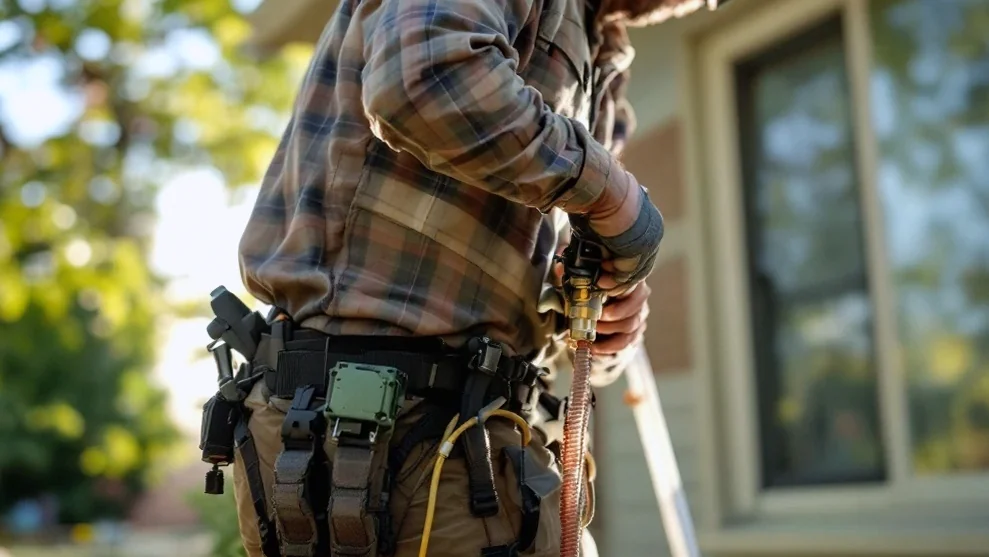
What is Radon Fan Replacement & Maintenance and how does it work?
Radon fan replacement and maintenance is the service of swapping out the motor that pulls soil gas from under your home and keeping the rest of the system clear. The fan is the only moving part, so it wears out. Most last 5 to 10 years, and replacement runs $200 to $600. (angi.com)
Your mitigation system is simple: a pipe runs from under the slab or from a sump pit up through the roof, with a fan mounted in the attic, on the exterior wall, or in the crawl space. The fan creates a vacuum that pulls radon-laden soil gas away before it enters your home. When the fan stops, that vacuum disappears and radon can rise back to pre-mitigation levels.
Maintenance is mostly about checking that the fan is still moving air and that nothing is blocking the pipe. We look at the u-tube manometer (the clear tube with colored liquid on the pipe) to confirm suction, listen for unusual noise, and inspect the exterior vent for nests or frost. If the fan is drawing high amps or the manometer shows no difference, it is time for a closer look.
In Huntsville, we see fans fail more often after long, hot summers. The motor runs continuously, and attic temperatures over 120 degrees shorten its life. That is why we tell homeowners to put a reminder on their calendar to check the manometer every three months. It takes ten seconds and can save you from breathing elevated radon for months.
- Fan is the only moving part, so it is the first thing to fail.
- Manometer reading tells you if the system is pulling vacuum.
- Listen for grinding or rattling, which means bearings are going.
- Check the vent outside for blockages like bird nests or ice.
Short version
- Fan replacement costs $200 to $600, averaging about $350. (angi.com)
- The fan unit alone runs $100 to $300. (homeguide.com)
- Most homeowners pay $300 to $600. (peerlessenvironmental.com)
- We check manometer, listen for noise, and inspect vent.
How Radon Fan Replacement & Maintenance works, start to finish
We start with a call or text, then schedule a visit. On site, we test the existing system, confirm the fan is dead or dying, and quote a replacement. If you approve, we swap the fan, seal connections, and verify suction. Most jobs take one to two hours.
The first step is a phone conversation. Tell us what you are seeing: is the manometer level, is the fan making noise, or did a radon test come back high? That helps us bring the right replacement fan. Fans are sized by duct diameter and static pressure, so we need to match the original specs or improve them if the system was undersized.
When we arrive, we check the u-tube manometer. If the liquid levels are even, the fan is not pulling. We then check power at the fan, inspect the pipe for disconnected joints, and look at the vent termination. Sometimes a fan is fine but a crushed pipe or a nest in the vent is the problem. We do not replace a fan that is still working.
If the fan is bad, we isolate power, remove the old unit, and install a new one with flexible couplings to reduce vibration. We seal every joint with UL-listed tape and mastic. After power is restored, we recheck the manometer to confirm a proper vacuum. We also do a quick smoke test at the suction point to make sure the system is pulling from the right place.
For maintenance, we recommend a yearly visit. We clean the vent screen, check the pipe supports, and test the fan amp draw. If the fan is drawing more than its rated amps, it is working too hard and will fail soon. Catching that early lets you plan the replacement instead of paying for an emergency call.
- Call or text to describe symptoms.
- We check manometer, power, and pipe condition.
- Replace fan with correct size and seal all joints.
- Verify suction and test amp draw.
- Schedule yearly maintenance to catch wear early.
- Diagnose.We check the manometer, listen to the fan, and inspect the pipe and vent. This tells us if the fan is the problem or if something else is blocking airflow.
- Quote.We give you a written price for the fan and labor. Most replacements fall in the $300 to $600 range. (peerlessenvironmental.com)
- Replace.We remove the old fan, install a new one sized for your duct, and seal all connections. We use flexible couplings to cut vibration and noise.
- Verify.We confirm the manometer shows a good vacuum and that the fan is drawing normal amps. We also check the vent for blockages.
Why Radon Fan Replacement & Maintenance matters for your home
Huntsville is a Zone 1 area for radon, and average levels are 4.0 pCi/L or higher. (swat-radon.com) A dead fan means your home can return to those levels. One local homeowner had 8.8 pCi/L in a finished basement and over 6 pCi/L on the main level. (indoor-air-health-advisor.com)
Radon is a radioactive gas that comes from soil and rock. In Huntsville, the geology includes limestone and shale that can produce radon. The EPA designates our area as Zone 1, which means the predicted average indoor radon screening level is greater than 4 pCi/L. That is the level where the EPA recommends mitigation. If your fan stops, you lose the only defense your system provides.
The health risk is lung cancer. Radon is the second leading cause of lung cancer in the U.S. after smoking. The risk goes up with concentration and exposure time. If your fan has been dead for six months, you and your family have been breathing elevated radon that whole time. You cannot see or smell it, so the only warning is your manometer or a radon test.
Maintenance protects the investment you already made. A standard slab-on-grade mitigation system in Huntsville runs $800 to $1,500 installed. (huntsvilleradonpros.com) Basement homes run $900 to $1,600. (huntsvilleradonpros.com) Replacing a fan for a few hundred dollars keeps that system working. Ignoring it can mean paying for a new system later if pipes freeze or the foundation depressurization fails.
We have seen homes in neighborhoods like Five Points and Blossomwood where the original fan lasted eight years. The homeowner never checked the manometer. When we tested, radon was back to 5.2 pCi/L in the living room. A $350 fan replacement fixed it. That is cheaper than a mitigation system and far cheaper than a health problem.
- Huntsville is Zone 1, so radon is common here.
- A dead fan means no vacuum, so radon can enter.
- Regular maintenance catches wear before levels rise.
- Replacing a fan is far cheaper than a new system.
Fan is noisy or running hot
Bearings are wearing. Plan a replacement within the next few months. Check the manometer weekly.
Manometer shows weak vacuum
The fan is losing power or a blockage is forming. Schedule a service visit within a few weeks.
Manometer is level or fan is silent
No suction. Radon can rise immediately. Call us today for a replacement.
Common problems and what causes them
Fan failure, blocked vents, and pipe leaks are the top three issues we see. Fans die from age and heat. Vents clog with nests or ice. Pipes leak at joints or get crushed. Each has a different fix, and not all require a new fan.
Fan motors wear out. The bearings dry up, the windings degrade, or the capacitor fails. In Huntsville, attic heat speeds this up. A fan that runs in a 130-degree attic may last five years instead of ten. If you hear grinding or the fan is hot to the touch, it is on its way out. We replace it with a fan rated for high-temperature environments when possible.
Blocked vents are common in older homes. Birds build nests in the vent pipe, or leaves pile up around the termination. In winter, frost can form and block airflow. When the vent is blocked, the fan works harder and can overheat. We always check the vent during maintenance. A quick cleaning can restore proper suction without replacing the fan.
Pipe leaks happen at joints and where the pipe passes through the roof. If a joint separates, the fan pulls air from the attic instead of the soil, so radon is not removed. We seal every joint with mastic and tape. On roof penetrations, we check the flashing and boot. A leak there can also let water into the attic, which is a separate problem.
Electrical issues can mimic fan failure. A tripped breaker, a loose wire, or a bad switch will stop the fan. We test power at the fan first. If there is no power, we trace the circuit. Sometimes the fix is a $10 switch, not a $350 fan. That is why we diagnose before we quote.
Finally, some systems were undersized from the start. If your fan runs constantly and the manometer still shows weak vacuum, the fan may be too small for your soil conditions. In that case, we may recommend a larger fan or a second suction point. That is a bigger job, but it solves the root cause.
- Fan motor wears out from age and heat.
- Vent blockages from nests, leaves, or ice.
- Pipe joint leaks reduce suction.
- Electrical problems can stop the fan.
- Undersized fans may need upgrading.
Worth it when
- Fan is over 7 years old and noisy.
- Manometer shows no vacuum.
- Radon test is above 4 pCi/L.
- You want to prevent future problems.
Hold off when
- Fan is quiet and manometer shows good vacuum.
- System was installed less than 3 years ago.
- You have not tested radon recently.
Costs and how long a replacement takes
Most homeowners pay $300 to $600 for a fan replacement. (peerlessenvironmental.com) The fan unit alone is $150 to $400. (peerlessenvironmental.com) Attic and crawl space placements cost more for access. The job usually takes one to two hours.
The total price depends on the fan size, where it is mounted, and how hard it is to reach. A fan on an exterior wall is easy. A fan in a tight attic or a crawl space takes longer. We charge more for those because of the extra time and safety gear. But even at the high end, you are looking at $600 or less for most homes. (angi.com)
If you need a new fan and the old one is a common size, we often have it on the truck. That means we can replace it the same day. If we need a specialty fan, it may take a few days to order. We will tell you the timeline upfront. We do not leave you with a dead system for weeks.
Maintenance visits cost less. We charge a service call fee that covers the inspection and cleaning. If we find a problem, we quote the repair before we do it. Many homeowners choose an annual maintenance plan so they never have to think about it. We send a reminder, you schedule, and we handle the rest.
One thing to watch: some companies charge a diagnostic fee and then credit it toward the replacement. We do that. If you decide not to replace, you just pay the diagnostic. That way you are not out a lot of money if the fan is fine and the problem is something else.
For budgeting, plan on $350 to $600 every 5 to 10 years. (angi.com) That is a small price for continuous radon reduction. Compare that to a new mitigation system at $800 to $1,600. (huntsvilleradonpros.com) Keeping your existing system alive is almost always the better deal.
- Typical replacement: $300 to $600. (peerlessenvironmental.com)
- Fan part only: $150 to $400. (peerlessenvironmental.com)
- Attic and crawl space access adds cost.
- Most jobs take 1 to 2 hours.
- Annual maintenance is cheaper than emergency repairs.
Day 1
You call or text. We ask a few questions and schedule a visit, often within 48 hours.
Day 2-3
We arrive, diagnose, and quote. If you approve, we replace the fan and verify suction.
Week 1
We follow up to confirm the manometer is holding. You can retest radon after 30 days if you want.
Check the downspout first: maintenance you can do yourself
You can check your system in under five minutes a month. Look at the manometer, listen to the fan, and look at the vent outside. If the manometer is level or the fan is silent, call us. If the vent is blocked, clear it if it is safe to reach.
The manometer is that clear tube with colored liquid on the pipe near the fan. When the fan is running, the liquid should be uneven. The difference shows the vacuum. If the levels are even, the fan is not pulling. That is your first clue. Check it monthly. It takes ten seconds.
Listen for the fan. A healthy fan makes a steady hum. Grinding, rattling, or a high-pitched whine means the bearings are failing. If you hear that, turn the system off at the switch (if there is one) and call us. Running a failing fan can damage the motor further and may cause electrical issues.
Go outside and look at the vent pipe. It should have a screen or a cap. If you see birds flying in and out, you have a nest. If leaves are packed around it, clear them. In winter, check for frost. A blocked vent makes the fan work harder. If you cannot reach the vent safely, leave it for us.
Check the pipe inside the house. Look for disconnected joints, cracks, or sagging. The pipe should slope slightly back toward the suction point so condensation drains. If you see water pooling in a low spot, that is a problem. We can fix it during a maintenance visit.
We recommend a professional maintenance visit once a year. We do a full inspection, clean the vent, test the fan, and check the electrical connections. It is a small cost that extends the life of your system and keeps radon levels low.
- Check manometer monthly for uneven levels.
- Listen for grinding or rattling noises.
- Clear blockages from the vent if safe.
- Look for pipe leaks or sagging.
- Schedule yearly professional maintenance.
Spring
Check vent for bird nests. Clean the screen. Test the fan amp draw.
Summer
Attic heat stresses the fan. Listen for noise. Check manometer weekly if attic gets above 120 degrees.
Fall
Clear leaves from around the vent. Check pipe joints for leaks before winter.
Winter
Check for frost blockages. Keep snow away from the vent. If fan is noisy, plan replacement before spring.
Sources
Need radon mitigation in Huntsville? Get a free estimate today.
📞 256-567-5330