What is Radon Mitigation and how does it work?
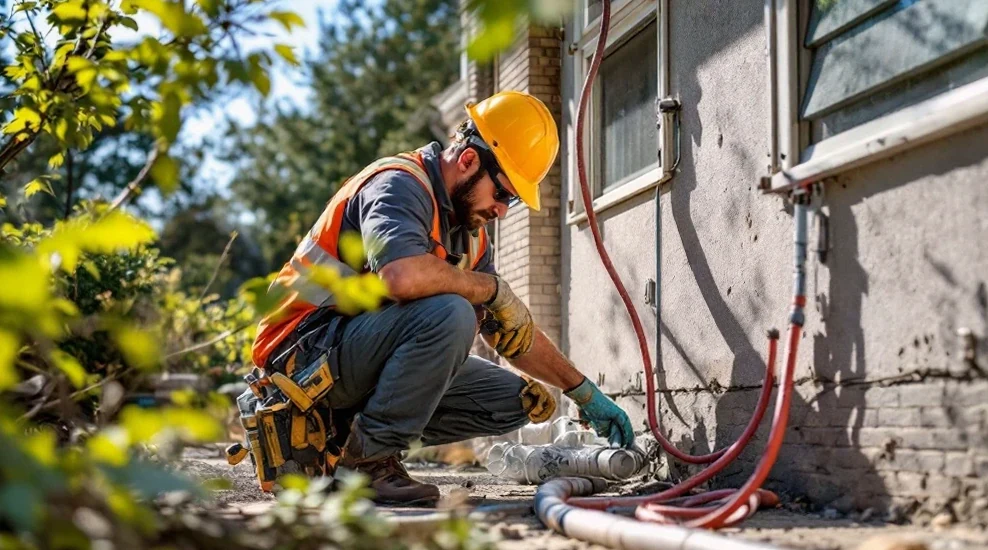
Radon mitigation is a system that pulls radon gas from under your home's foundation and vents it safely above the roofline. The most common type, active soil depressurization, uses a fan and PVC piping to create negative pressure beneath the slab.
Think of it this way: your house sits on soil that naturally releases radon gas. That gas seeps through cracks in your foundation, gaps around pipes, and even through concrete itself. A mitigation system flips the script. Instead of letting the gas push up into your living space, a fan creates a vacuum under the slab, drawing the gas into a pipe and exhausting it outside, high above the roof where it disperses.
The core of the system is a vent fan, usually installed in the attic or on the exterior of the home. The fan continuously runs, pulling air from beneath the slab or from a crawlspace liner. That air, carrying the radon, travels up a PVC pipe and exits through a vent above the roofline. The result is a dramatic drop in indoor radon levels, often to near outdoor background levels.
For a typical slab-on-grade home in Huntsville, this system runs $800 to $1,500 installed, with more complex homes reaching $2,500 or more. (angi.com) That range covers the standard setup: a suction point in the slab, PVC piping, an inline fan, and the vent. Homes with crawlspaces, multiple slabs, or tricky layouts can push toward the higher end.
The EPA and the U.S. Surgeon General recommend fixing any home that tests at or above 4.0 pCi/L. (alabamapublichealth.gov) That's the threshold that triggers action. If your test came back above that, a mitigation system is the proven fix.
- Active soil depressurization: the standard and most effective method
- Fan and PVC pipe create suction under the slab
- Vent above roofline safely disperses radon
- Typical cost: $800 to $1,500 for standard homes
Short version
- A fan pulls radon from under your foundation and vents it above the roof.
- Most homes need one suction point and a simple pipe run.
- Costs usually land $800 to $1,500 for a standard slab home.
- Continuous operation lowers radon to near outdoor levels.
How Radon Mitigation Works, Start to Finish
The process starts with a radon test to confirm the problem, then our crew installs a sub-slab suction system. We drill a hole in the slab, insert a pipe, seal it, run the pipe to an attic or exterior fan, and vent it above the roofline.
Before any installation, we test your home to get a baseline reading. If you've already tested and the result was above 4.0 pCi/L, we use that number as our starting point. (alabamapublichealth.gov) The test also tells us where to place the suction point, usually in a utility area or closet where the pipe can run discreetly.
The installation itself is straightforward for a slab-on-grade home. We start by drilling a 4-inch hole through the concrete floor, typically in a basement or a ground-floor closet. Then we dig out a small pit beneath the slab to create a collection area for the gas. A 3-inch PVC pipe is inserted into the hole and sealed to the concrete with a high-quality urethane caulk or a rubber boot. That seal is critical; it forces the fan to pull air from under the slab, not from the room.
From there, the pipe runs up the wall, through the attic, and out the roof. The fan, which is the heart of the system, gets installed either in the attic or on the exterior. Attic installations are quieter and keep the fan out of the weather, but they require the fan to be accessible for maintenance. Exterior fans are easier to service but add a visible element to the outside of your home. We'll talk through which makes sense for your house.
The vent pipe must terminate at least 10 feet from any window, door, or other opening, and at least 12 inches above the roofline. That keeps the radon from being pulled back into the house. We also install a manometer, a small U-shaped tube filled with liquid, on the pipe. It shows whether the fan is working. If the liquid levels are even, the fan has lost suction and needs attention.
Once the system is running, we do a follow-up radon test, usually 24 to 48 hours later, to confirm levels have dropped. In most cases, a properly installed system brings levels down to 2.0 pCi/L or lower, often close to the outdoor average of 0.4 pCi/L. (alabamapublichealth.gov)
- Test first.A short-term test gives you a baseline. If it's above 4.0 pCi/L, mitigation is recommended.
- Locate the suction point.We pick a spot that allows a clean pipe run and good access under the slab.
- Drill and seal.A hole through the slab, a pit dug below, and a pipe sealed in place.
- Run the pipe.PVC pipe travels up and out, terminating above the roofline.
- Install the fan.The fan creates the vacuum that pulls radon from under the house.
- Verify with a test.A post-mitigation test confirms the system is working.
Why Radon Mitigation Matters for Your Home
Radon is the second leading cause of lung cancer in the U.S., and Madison County sits in a zone with high radon potential. Testing and mitigation are the only ways to reduce your exposure.
Madison County is one of the 15 Alabama counties the state names as having the highest radon potential, alongside Colbert, Franklin, Jackson, Lauderdale, Lawrence, Limestone and Morgan across north Alabama. (alabamapublichealth.gov) That's not a scare tactic; it's geology. Our area's soil and rock formations contain uranium, which decays into radon gas. The gas moves up through the ground and into your home through any opening it can find.
Indoor radon averages about 1.3 pCi/L nationally, and outdoor air about 0.4 pCi/L. (alabamapublichealth.gov) So an indoor reading several times higher is the signal to act. (alabamapublichealth.gov) If your test comes back at 4.0 pCi/L or above, the EPA recommends fixing it. (alabamapublichealth.gov) That's not a suggestion; it's a clear guideline based on decades of health data.
What does that mean for you? If you've lived in your Huntsville home for years without testing, you've been exposed to whatever level is present. The good news is that mitigation is a one-time fix that runs continuously. It's not a filter you have to change or a treatment you repeat. Once installed, it works around the clock, pulling radon away from your living space.
Some homeowners wonder if they can just open windows or seal cracks. Opening windows helps short-term, but it's not a permanent solution. Sealing cracks alone won't stop radon, because the gas can still seep through the concrete itself. A mitigation system addresses the source, the soil beneath your home, rather than just the symptoms.
A mitigation system is a one-time fix that runs continuously, pulling radon away from your living space.
Common Problems and What Causes Them
Most radon problems in Huntsville homes come from the same handful of issues: slab cracks, sump pump pits, crawlspaces, and poor ventilation. Identifying the entry point is the first step to solving it.
Slab cracks are the most obvious culprit. Concrete shrinks as it cures, and over time, temperature changes and settling can open up hairline fractures. Radon gas, being a gas, follows the path of least resistance. Those cracks are like open doors for it. A mitigation system, however, doesn't rely on sealing every crack. The suction under the slab intercepts the gas before it finds those openings.
Sump pump pits are another common entry point. The pit is a hole in your slab, and if it's not sealed, it's a direct channel for radon. We see homes where the sump pit cover is just a loose piece of plywood. That's not doing anything to stop radon. A proper mitigation system either seals the pit and vents it, or incorporates it into the suction field.
Crawlspace homes present a different challenge. The dirt floor is a massive source of radon. The fix here is a heavy-duty vapor barrier laid over the entire crawlspace floor, sealed to the walls, with a suction pipe running beneath the barrier. This is more involved than a slab system, which is why costs can climb toward the $2,500 mark for complex homes. (angi.com)
Another issue we run into is a home that was built with a radon system already in place, but the fan has failed or been disconnected. We see this a lot in homes that had a passive system installed during construction, a pipe with no fan. Over time, the pipe gets clogged or the fan burns out. If you've bought a home with a system, check the manometer. If the liquid is level, the fan isn't running, and you're not protected.
One more thing: some homes test high only in certain seasons. Radon levels can spike in winter when the house is closed up and the stack effect pulls more soil gas inside. A single test in summer might come back low, but that doesn't mean you're in the clear. If you're testing for the first time, do it in the winter if you can. If you've already mitigated, a winter retest is a good way to confirm the system is handling the worst-case conditions.
Low test, no symptoms
Levels below 2.0 pCi/L are fine. Retest every two years or after major renovations.
Levels between 2.0 and 4.0
Not an emergency, but consider mitigation. These levels are above average and worth addressing.
Levels at or above 4.0
The EPA recommends fixing it. Schedule a mitigation installation as soon as possible.
Sources
Need radon mitigation in Huntsville? Get a free estimate today.
📞 256-567-5330