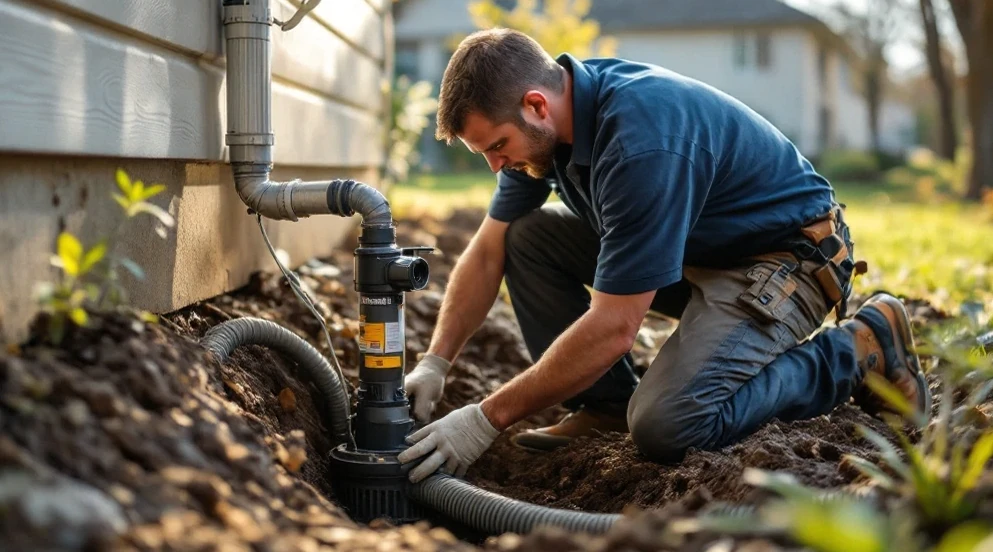
What is Radon Sump Pump Installation and how does it work?
Radon sump pump installation creates a sealed suction point in your basement or crawlspace that draws radon gas from the soil beneath your home and vents it safely outside. It's one of the most effective mitigation methods for homes with high radon levels.
Think of it as a dedicated vacuum for the ground under your house. We cut a small hole in your slab or sump pit, seal it with a cover, and connect a pipe to a fan that runs continuously. That fan pulls air from the soil, which carries radon gas with it, and pushes it up and out through a vent pipe that ends above your roofline. The gas never enters your living space.
In Huntsville, many homes have a sump pit already because of the clay-heavy soil and seasonal rain. That pit is a natural collection point for soil gas, which is exactly why radon levels often spike near it. Sealing that opening and attaching a suction pipe turns a problem into a solution.
A typical radon sump system runs around £800, but can land closer to £2000 depending on the size of your home and the complexity of the installation. (ukradon.org) The fan itself costs $100 to $300, and that's part of the overall price. (homeguide.com)
The key is that the system is passive until the fan runs. It's not like a water sump pump that kicks on when the pit fills. The radon fan runs 24/7, year-round, and it's quiet enough that you'll forget it's there.
- Seals the largest opening between your basement and the soil
- Draws radon from under the slab before it can enter your home
- Vents the gas above the roofline, away from windows and doors
- Works continuously, not just during rain or high water
Short version
- A radon sump system is a sealed suction point that pulls soil gas out and vents it above the roof.
- It's a permanent, low-maintenance fix for high radon levels.
- Costs typically run £800 to £2000, with the fan itself at $100 to $300.
How Radon Sump Pump Installation works, start to finish
We start with a diagnostic test to confirm radon levels, then create a sealed suction point in your sump pit or slab, run a pipe to a fan, and vent it above the roofline. The whole process usually takes a day, sometimes two for tricky layouts.
First, we test your home's radon levels. If they're at or above 4.0 pCi/L, the EPA recommends mitigation. (dupageradon.com) That test tells us how strong the system needs to be and where the suction point should go.
Next, we inspect your sump pit. If you have one, we clean it out and seal it with a custom cover that has a gasketed opening for the suction pipe. If there's no pit, we cut a small hole in the slab in the most effective location, usually near the center of the home or where the soil is most porous.
Then we install the pipe. It runs from the suction point, through the basement or crawlspace, and up to the fan. The fan mounts on the exterior wall or in the attic, depending on your home's layout. Finally, we route the vent pipe above the roofline, at least 10 feet from any window or door, and seal every joint to keep the system airtight.
After the install, we run a follow-up test to confirm the system is bringing levels down. That test usually takes 48 hours, and we'll share the results with you. If levels are still high, we adjust the fan speed or add a second suction point.
The whole job is clean. We use a dust barrier around the work area, and we patch the concrete we cut. You won't be left with a mess or a hole in your floor.
- Test first.We measure radon levels to confirm the problem and determine the system size.
- Seal the sump.We clean and seal your existing sump pit, or cut a new suction point in the slab.
- Run the pipe.We connect the suction point to a fan and route the vent above the roofline.
- Verify.A follow-up test confirms levels are down, and we adjust if needed.
Why Radon Sump Pump Installation matters for your home
Radon is the second leading cause of lung cancer in the U.S., and Huntsville's soil and rock formations make it a concern. A sump system addresses the most common entry point and can cut radon levels dramatically.
Your sump pit is a direct opening from the ground to your basement. Soil gas, which carries radon, moves through the soil and finds the path of least resistance. That pit is a wide-open highway. A sump pump cover may help to slightly reduce radon levels because it blocks that major opening. (dupageradon.com) But covering it isn't enough, especially if levels are at or above 4.0 pCi/L. (dupageradon.com)
The sump pump isn't the only point of entry for radon gas. (dupageradon.com) Cracks in the slab, gaps around pipes, and even the wall-floor joint all let gas in. A sump system pulls from the entire zone under the slab, creating a negative pressure that draws gas toward the suction point instead of into your living space. That's why it's more effective than just sealing the pit.
In Huntsville, the karst topography and limestone bedrock mean radon levels can vary wildly from one street to the next. A neighbor might test at 2 pCi/L while you're at 8. That's why we test every home individually, and why a system that works for one house might not be enough for another.
The health risk is present, but the fix is straightforward. A properly installed sump system can bring levels down to near outdoor levels, often in the 1 to 2 pCi/L range. That's a big change for a one-day job.
Levels under 2 pCi/L
No action needed, but retest every two years or after any major foundation work.
Levels 2 to 4 pCi/L
Consider mitigation, especially if you spend a lot of time in the basement or have kids.
Levels at or above 4 pCi/L
Mitigate as soon as possible. This is the EPA action level, and a sump system is a proven fix.
Common problems and what causes them
Most radon sump system failures trace back to poor sealing, undersized fans, or incorrect vent placement. We've seen it all, and here's what goes wrong and how to avoid it.
The most common mistake is just putting a cover on the sump pit without a fan. That blocks the opening but does nothing to pull gas out. Levels stay high because the gas finds another route. A cover alone is not a mitigation system. (dupageradon.com)
Another issue is a fan that's too small for the footprint of the house. A 1,200-square-foot ranch needs a different fan than a 3,000-square-foot two-story with a finished basement. We size the fan based on the square footage, the soil type, and the test results. Undersized fans leave levels above the action level, and you're back to square one.
Vent placement matters, too. If the vent exits near a window, an air conditioner, or a porch where people sit, the radon can get pulled right back inside. The vent needs to be above the roofline and at least 10 feet from any opening. Some quick jobs don't do this, and the homeowner ends up with a system that's technically running but not helping.
Condensation is another issue, especially in humid Huntsville summers. Warm, moist air from the soil meets the cooler pipe and condenses. If the pipe isn't pitched properly, water pools and blocks the airflow. We install a drain tee at the low point to handle this.
Finally, some outfits cut corners on the seal. A suction point that isn't airtight pulls air from the basement instead of the soil, which defeats the purpose. We use a gasketed cover and seal every penetration with polyurethane caulk. It's the difference between a system that works and one that just makes noise.
A sump cover alone is not a mitigation system. Without a fan, you're just closing a door while the windows are open.
Frequently Asked Questions
How much does radon sump pump installation cost in Huntsville?
A typical radon sump system runs around £800, but can be around £2000 depending on your home's size and layout. (ukradon.org) The fan itself runs $100 to $300. (homeguide.com) We'll give you an exact quote after a free on-site assessment.
Will a sump pump cover alone fix my radon problem?
A sump pump cover may help to slightly reduce radon levels because it blocks a major opening from the ground to your basement. (dupageradon.com) But it's not enough if your levels are at or above 4.0 pCi/L. (dupageradon.com) You need a fan to actively pull gas out.
How long does installation take?
Most installations take one day. A more complex layout, like a crawlspace with limited access or a multi-zone system, can stretch to two days. We'll give you a time estimate when we come out to look.
Will the radon fan be loud?
Modern radon fans are quiet. You'll hear a low hum if you're right next to it, but it's not noticeable from living spaces. The fan runs 24/7, so we install it where the sound won't bother you.
Does the system work in winter?
Yes, and it's more important in winter when homes are sealed up and the stack effect pulls soil gas inside. The fan runs year-round, and the vent pipe is insulated where it passes through unheated spaces to prevent condensation issues.
What if my radon levels are still high after installation?
We run a follow-up test after every install. If levels are still above the action level, we'll adjust the fan speed, add a second suction point, or seal additional entry points. The goal is to get you under 2 pCi/L, and we don't stop until we do.
Can a radon sump system be installed in a crawlspace?
Yes. In a crawlspace, we seal the ground with a vapor barrier and create a suction point under it. It's a different setup than a basement sump pit, but the principle is the same. We'll recommend the best approach based on your home's foundation.
How often does the system need maintenance?
The fan has a lifespan of 5 to 10 years. Check the manometer (the U-tube gauge) monthly to make sure the system is pulling. If the fluid levels are equal, the fan may have failed, and you'll need a replacement. Other than that, there's nothing to do.
Will the system affect my home's resale value?
A properly installed radon system is a selling point. Buyers in Huntsville are increasingly asking for radon tests, and a working system means one less contingency. It's a permanent fix that shows the home is safe.
Do you guarantee the system will work?
Yes. We guarantee our systems will lower your radon levels below the EPA action level of 4.0 pCi/L. (dupageradon.com) If they don't, we'll come back and make adjustments at no charge.
Sources
Need radon mitigation in Huntsville? Get a free estimate today.
📞 256-567-5330