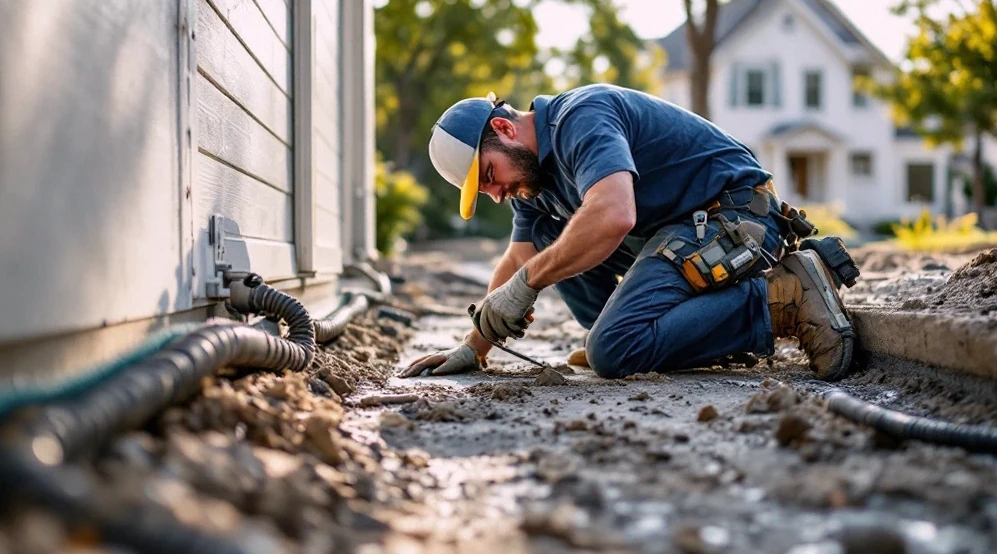
What is Sub-Slab Depressurization System Installation and how does it work?
Sub-slab depressurization installation means putting a pipe through your basement or slab floor, connecting it to a fan that runs continuously, and venting radon-laden soil gas above your roof. The fan creates a vacuum under the slab, so radon goes out the pipe instead of seeping into your home.
Radon forms naturally from uranium in soil and rock. In Huntsville, we sit on limestone and shale that can produce radon at levels worth paying attention to. The gas moves through the soil and enters your home through cracks in the slab, sump pits, floor drains, and gaps around pipes. A sub-slab depressurization system stops that migration by reversing the pressure difference.
The system has four main parts: a suction point (a hole cored through the slab), PVC piping that runs from that hole to the outside, a radon fan mounted on the exterior wall or in the attic, and a vent pipe that discharges above the roofline. When the fan runs, it pulls soil gas from under the slab and pushes it out the top of the pipe. The vacuum extends a few feet in every direction from the suction point, which is why one or two suction points usually cover an entire foundation.
Installation typically takes one day for a standard slab-on-grade home. Our crew cores the slab, digs a small pit to create a collection area, runs the pipe through the house or along the exterior, mounts the fan, and seals everything back up. We also install a manometer, a small gauge that shows the fan is pulling vacuum. You can check it at a glance to know the system is working.
Cost for a standard slab-on-grade home in Huntsville runs $800 to $1,500 installed. (huntsvilleradonpros.com) For basement and more complex foundations, active sub-slab suction typically installs for roughly $790 to $1,280. (homeguide.com) Those ranges assume normal access and a single suction point. Larger homes, multiple suction points, or finished basements can push the price higher.
- One suction point covers most slab-on-grade homes up to about 2,000 square feet.
- Runs 24/7 and uses about as much electricity as a 75-watt light bulb.
- A manometer on the pipe shows the system is pulling vacuum.
- Vent discharge must be above the roofline and away from windows or doors.
Short version
- A hole is cored through your slab, a pipe is run to the outside, and a fan pulls soil gas away from your home.
- Installation usually takes one day and costs $800 to $1,500 for a standard Huntsville slab home. (huntsvilleradonpros.com)
- It runs continuously and needs little maintenance beyond checking the manometer and listening for fan noise.
How Sub-Slab Depressurization System Installation works, start to finish
Installation starts with a radon test to confirm the problem and locate the best suction point. Then we core the slab, dig a small pit, run PVC pipe to the exterior, mount the fan, and seal everything. The whole process takes four to eight hours for a typical home.
Before we cut anything, we look at your test results and your foundation layout. A short-term test tells us the radon level, but the suction point location depends on where the gas is entering and how the slab is built. In Huntsville, we see a lot of slab-on-grade and basement homes, plus some crawl spaces that need a different approach. For sub-slab depressurization, we need a continuous slab or a basement floor we can core through.
The first step is coring a 4-inch hole through the slab. We use a wet-core drill to keep dust down. Under the slab, we dig a small pit, usually about 12 to 18 inches across and 6 to 10 inches deep. That pit gives the suction point a collection area so the vacuum spreads out instead of pulling from one narrow spot. In some homes, we add a second suction point if the slab is large or divided by footings.
Next comes the pipe. We run 3-inch or 4-inch PVC from the suction pit up through the house or along the exterior wall. Most Huntsville homes have us route the pipe through a closet, garage, or utility chase to keep it out of sight. If we go outside, we use schedule 40 PVC and secure it every few feet. The goal is a straight, short run with as few elbows as possible, because every bend reduces airflow.
The fan mounts on the exterior wall or in the attic. We wire it to a dedicated circuit or a nearby outlet, depending on local code. After the fan, the vent pipe continues up past the roofline. We cut the pipe so it discharges at least 12 inches above the roof surface and at least 10 feet away from any window, door, or intake vent. That keeps the radon from being pulled back inside.
Finally, we seal the slab penetration with hydraulic cement or polyurethane caulk, and we seal any other openings we find, like sump lids or floor drains. A manometer goes on the pipe so you can see the vacuum. We also label the system with our contact info and the installation date. Once everything is buttoned up, we run the fan and check the vacuum with a micromanometer to confirm it is pulling from under the slab.
From start to finish, a typical installation takes four to eight hours. If we need to run pipe through finished spaces or add a second suction point, it can stretch to a full day. We always test again 24 to 48 hours after installation to confirm the radon level has dropped.
- Test and plan.We review your radon test and inspect the foundation to choose the best suction point location.
- Core and dig.A 4-inch hole is cored through the slab, and a small pit is dug to create a collection area.
- Run the pipe.PVC pipe is routed from the pit to the exterior or attic, keeping the run as straight as possible.
- Mount the fan.The radon fan is installed on the exterior wall or in the attic and wired to power.
- Vent above the roof.The discharge pipe is extended above the roofline, away from windows and intake vents.
- Seal and verify.All openings are sealed, a manometer is installed, and we confirm the vacuum is working.
Why Sub-Slab Depressurization System Installation matters for your home
Radon is the second leading cause of lung cancer in the U.S., and the EPA recommends mitigation when levels reach 4 picocuries per liter or higher. A sub-slab system drops radon levels by up to 99 percent, protecting everyone in the house without requiring you to change how you live.
Huntsville sits in an area with moderate to high radon potential. The Tennessee Valley has pockets of uranium-bearing rock that can produce elevated radon levels. Two houses on the same street can test very differently because of soil composition, foundation type, and how the home was built. That is why testing is the only way to know what you are dealing with.
When radon enters a home, it decays into radioactive particles that can be inhaled. Those particles can damage lung tissue over time. The risk is higher for smokers, but non-smokers are affected too. The EPA estimates that radon causes about 21,000 lung cancer deaths each year in the U.S. A sub-slab depressurization system reduces that risk by keeping the gas out of your living space.
Beyond health, a mitigation system can affect your home's value. When you sell, a buyer's inspector may test for radon. If levels are high, you will likely need to mitigate before closing. Having a system already installed and a post-mitigation test showing low levels can make the sale smoother. It also shows the work was done by a qualified installer, which matters to buyers.
Installation costs for a standard slab-on-grade home in Huntsville run $800 to $1,500. (huntsvilleradonpros.com) For more complex foundations or higher-end systems, costs can reach $2,500 or more. (radonseal.com) That is a one-time expense for a system that runs for years with minimal upkeep.
Some homeowners ask if they can just seal cracks and call it done. Sealing alone does not reduce radon levels enough to matter. The gas will find another path. Sub-slab depressurization works because it changes the pressure under the slab, so radon never enters in the first place. That is why it is the most common and most effective method for slab and basement homes.
If your radon test reads 4 pCi/L or higher, sub-slab depressurization is the standard fix. It is the most reliable way to bring levels down, and it works around the clock without you thinking about it.
Common problems and what causes them
Most problems come from poor suction point placement, undersized pipe, or a fan that has failed. A system that was not sealed properly can also lose vacuum. Regular checks of the manometer and a retest every two years catch these issues early.
One common issue we see in Huntsville is a system installed with too small a pipe or too many elbows. Radon systems need to move a lot of air with very little pressure. If the pipe run is long or narrow, the fan has to work harder and may not pull enough vacuum. We use 3-inch or 4-inch pipe and keep the run as straight as we can. If we have to make turns, we use long-sweep elbows instead of sharp 90s.
Another problem is a fan that stops running. Radon fans are designed to run continuously for years, but they do wear out. The average lifespan is about 5 to 10 years. When a fan fails, the manometer will show no vacuum. You might also hear the fan making noise or not running at all. If that happens, call us. We can replace the fan and check the rest of the system.
Improper sealing around the suction point or other slab openings can also reduce performance. If the slab has a sump pit, we seal the lid. If there are floor drains, we can install a trap primer or a one-way valve. Any gap that lets air in from the house can short-circuit the vacuum. We check for these during installation and fix them as part of the job.
In some homes, a single suction point is not enough. Large slabs, multiple foundation sections, or homes with a lot of gravel under the slab may need two or more suction points. We determine that by testing the vacuum at different points after installation. If the vacuum does not extend far enough, we add another point. That is why we do a post-installation test and a follow-up test a few days later.
Weather can affect radon levels, too. During heavy rain, the soil gets saturated and radon can be pushed into the home more forcefully. In winter, the stack effect is stronger because the house is warm and the air outside is cold. That can pull more soil gas in. A properly designed system handles these swings, but if you notice your levels creeping up, give us a call. We can check the system and adjust if needed.
- Fan failure: manometer reads zero, system stops pulling vacuum.
- Undersized pipe: fan strains, radon levels stay high.
- Poor sealing: air from the house short-circuits the vacuum.
- Single suction point on a large slab: vacuum does not reach all areas.
- Weather changes: heavy rain or cold snaps can raise radon levels temporarily.
Manometer shows low vacuum
The system is still running but not pulling as it should. Check for leaks or a partially blocked pipe. Call us to inspect.
Fan is noisy or cycling
The fan may be failing. It could stop entirely soon. Schedule a replacement before it quits.
Manometer reads zero and fan is silent
The system is not working. Radon levels can rise quickly. Call us for a same-week fan replacement.
Frequently Asked Questions
How much does sub-slab depressurization installation cost in Huntsville?
For a standard slab-on-grade home, installation runs $800 to $1,500. (huntsvilleradonpros.com) More complex foundations or systems with multiple suction points can push the price toward $2,500. (radonseal.com) We provide a free on-site quote so you know the exact cost before we start.
How long does installation take?
Most installations take four to eight hours. If we need to run pipe through finished spaces or add a second suction point, it can take a full day. We schedule the work and let you know what to expect.
Will the system make noise?
The fan makes a low hum, similar to a bathroom vent fan. You will hear it if you stand near the exterior wall where it is mounted, but inside the house it is usually quiet. If the fan gets loud, that is a sign it may be failing.
How often should I check the system?
Check the manometer once a month. It should show a consistent vacuum. If the reading changes or drops to zero, call us. We also recommend a radon test every two years to confirm the system is still keeping levels low.
Can I install a sub-slab depressurization system myself?
We do not recommend it. The work involves coring through a concrete slab, running electrical wiring, and properly sealing the system. Mistakes can reduce performance or create safety issues. A licensed installer will make sure the system is sized and installed correctly.
What if my home has a crawl space instead of a slab?
Crawl spaces need a different approach, usually a sub-membrane depressurization system. We install a heavy-duty plastic liner over the crawl space floor and pull suction from under it. The idea is the same, but the materials and labor differ. We can handle both types.
Does the system need maintenance?
Very little. The fan is the main wear item and typically lasts 5 to 10 years. Keep the vent pipe clear of debris and check the manometer monthly. If you notice any change, call us. We can replace the fan and inspect the system.
How do I know if the system is working?
The manometer shows the vacuum. If it reads the same as when we installed it, the system is working. You can also do a follow-up radon test after installation and every two years. If levels stay below 4 pCi/L, the system is doing its job.
Will the system increase my energy bills?
The fan uses about as much electricity as a 75-watt light bulb running continuously. That adds a few dollars a month to your bill. The cost is minor compared to the health risk of elevated radon.
What if I am selling my home?
A radon mitigation system can be a selling point. If a buyer's inspector finds high radon, you will likely need to mitigate anyway. Having a system already installed and a post-mitigation test showing low levels can make the sale smoother and show buyers the work was done right.
Sources
Need radon mitigation in Huntsville? Get a free estimate today.
📞 256-567-5330