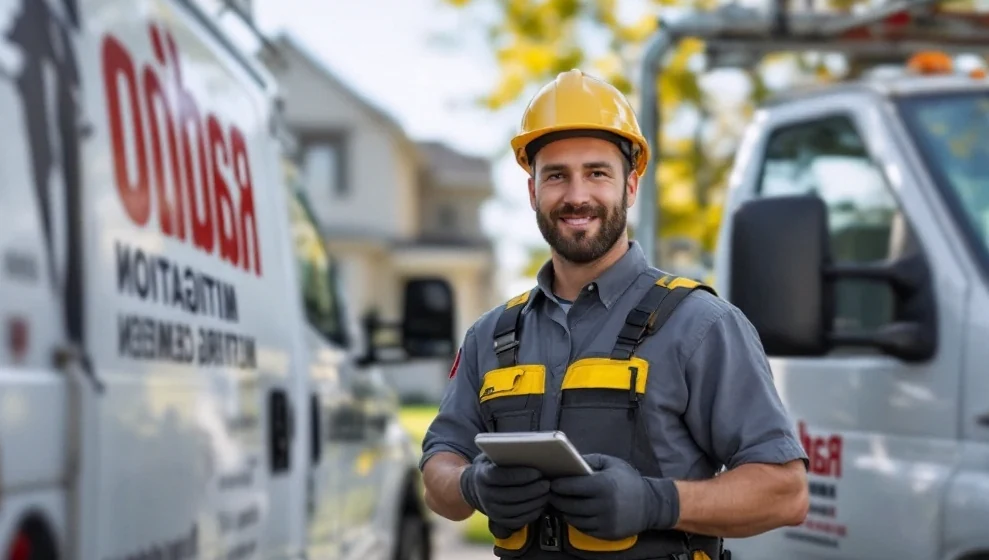
Quick answers on Radon Mitigation in Huntsville
Radon mitigation in Huntsville usually means installing an active soil depressurization system. For a typical slab-on-grade home, that runs $800 to $1,500 installed. (huntsvilleradonpros.com)
Huntsville sits in a Zone 1 radon area, meaning average indoor radon levels run 4.0 pCi/L or higher. (swat-radon.com) That's the level where the EPA and the U.S. Surgeon General say you should fix your home. (alabamapublichealth.gov) If you've tested and come in at or above that number, you're not alone, and the fix is straightforward.
The standard fix is active sub-slab suction. A pipe goes through your slab, a fan pulls soil gas from underneath, and it vents safely above the roofline. Nationally, that runs about $790 to $1,280 for a typical slab or basement home. (homeguide.com) In Huntsville, where many homes are slab-on-grade, you're usually looking at $800 to $1,500 installed. (huntsvilleradonpros.com)
That range covers the fan, the piping, the labor, and the sealing. It doesn't cover testing or permits, which add $150 to $700 and $25 to $150 respectively. (angi.com) Most homeowners in Madison County pay somewhere in the middle, but the only way to get an exact number is a free on-site quote from us. We'll look at your foundation type, your roof line, and where the fan can go, then give you a firm price.
- Standard active soil depressurization: $800 to $1,500 installed for slab homes in Huntsville. (huntsvilleradonpros.com)
- National average for remediation: about $1,000, with most homeowners paying $800 to $1,300. (angi.com)
- HomeGuide's range across all home types: $800 to $2,500. (homeguide.com)
- Complex homes can reach $2,500 or more. (angi.com)
Short version
- Huntsville is Zone 1 for radon, so testing matters here. (swat-radon.com)
- Active sub-slab suction fixes most homes, costing $800 to $1,500 installed locally. (huntsvilleradonpros.com)
- Budget extra for testing and permits on top of the system. (angi.com)
- Fix any home testing at 4.0 pCi/L or higher. (alabamapublichealth.gov)
How radon mitigation works
Radon mitigation pulls soil gas from under your home and vents it above the roofline. The most common method, active sub-slab suction, uses a fan to create negative pressure under the slab, so radon never enters your living space. (homeguide.com)
Radon is a radioactive gas that comes from uranium in the soil. It seeps through cracks in your foundation, gaps around pipes, and even through the slab itself. The goal of mitigation isn't to block every crack, it's to create a low-pressure zone under the slab that draws the gas away before it can get inside.
Here's how the system works. We drill a hole through your slab, usually in a utility closet or the garage. We dig a small pit underneath, insert a pipe, and seal around it. The pipe runs up through the house, often through an interior wall or an attached garage, and exits above the roofline. A fan installed in the pipe, usually in the attic or on the exterior, pulls air from under the slab and vents it outside.
That fan runs continuously. It's a wear item, and you'll replace it every 5 to 10 years, at a cost of roughly $200 to $600, averaging about $350. (angi.com) Attic and crawl space placements cost more because of the extra labor and access challenges. (angi.com)
For crawl space homes, the approach changes. Instead of a slab penetration, we lay a heavy-duty membrane over the dirt floor, seal it to the foundation walls, and vent the space under the membrane. That's a sealed sub-membrane system. The membrane alone runs $800 to $3,000, and full crawl space encapsulation ranges from $1,500 to $15,000 depending on size and access. (bobvila.com)
- Test first.We run a professional radon test, which costs $150 to $700. (angi.com) Short-term tests take 2 to 7 days; long-term tests give a better yearly average.
- Plan the route.We find the best spot for the pipe, the fan, and the exit point. That determines the final price, since complex routes cost more.
- Install the system.For slab homes, that's a hole, a pipe, a fan, and sealing. For crawl spaces, it's a membrane, a vent, and a fan.
- Retest.After installation, we run another test to confirm levels dropped below 4.0 pCi/L. That's the EPA's action level. (alabamapublichealth.gov)
What drives the cost in Huntsville
Your home's foundation type is the biggest price driver. Slab homes are cheaper to mitigate, crawl spaces cost more, and complex layouts can push the price to $2,500 or more. (angi.com)
The national average for radon remediation is about $1,000, with most homeowners paying between $800 and $1,300. (angi.com) But that's a national figure. In Huntsville, where many homes are slab-on-grade, you'll likely land in the $800 to $1,500 range. (huntsvilleradonpros.com)
What pushes a price up? First, the number of slabs. A home with a basement and a slab-on-grade addition might need two suction points. That means more piping, more labor, and a higher price. Second, the roof line. A steep roof or a two-story home makes the exterior vent run longer and harder to access, so costs climb. Third, the fan placement. An attic fan is easier to service but harder to install; an exterior fan is simpler but more exposed.
Crawl space homes are the pricey ones. The membrane alone runs $800 to $3,000, and full encapsulation can reach $15,000 if you're also dealing with moisture and insulation. (bobvila.com) That's why we always quote after seeing the space. A tight crawl space with low clearance adds hours to the job.
HomeGuide's full range across all home types is $800 to $2,500. (homeguide.com) That's a realistic bracket for Huntsville, where most homes fall in the lower half, but complex ones can hit the top. We'll give you a firm number before we start, and we don't pad it with surprise add-ons.
Worth it when
- You have a basement with a finished living area below grade.
- Your test came back above 4.0 pCi/L and you have kids or a smoker in the house.
- You're selling a home and the buyer's inspection flagged radon.
Hold off when
- You haven't tested yet. Test first, then decide.
- Your levels are below 4.0 pCi/L. The EPA says no fix needed. (alabamapublichealth.gov)
- You're planning a major remodel that will disturb the slab. Do mitigation after.
Mistakes we see homeowners make
The biggest mistake is not retesting after mitigation. A system can fail silently, and the only way to know it's working is to test again. Another is hiring a handyman who doesn't understand soil gas dynamics.
We've been in enough Huntsville crawl spaces to see the same errors repeated. One is sealing the slab without venting. That just traps radon under the plastic, and it seeps out the edges. Another is putting the fan in the basement instead of venting it outside. That recirculates radon into the living space.
Some outfits will quote a flat price without looking at your foundation. Then they show up and tack on fees for 'unexpected conditions.' We don't work that way. We inspect first, quote a firm price, and stick to it.
The other mistake is assuming a single test is enough. Radon levels fluctuate with the seasons, barometric pressure, and how you run your HVAC. A short-term test might catch a spike or a lull. That's why we recommend a long-term test before you commit to a $1,200 system.
And don't forget the fan. It runs 24/7, and it wears out. Budget for a replacement every 5 to 10 years, at $200 to $600. (angi.com) Some homeowners ignore the warning signs, like a louder fan or a higher electric bill, and their radon levels creep back up without them knowing.
Why Huntsville homes test high
Madison County is one of 15 Alabama counties the state names as having the highest radon potential. (alabamapublichealth.gov) The geology here, with its limestone and shale, releases uranium as it decays, and that's what produces radon.
The EPA designates Huntsville as a Zone 1 area, meaning average indoor radon levels are 4.0 pCi/L or higher. (swat-radon.com) That's not a scare tactic, it's a statistical fact. The Alabama Department of Public Health lists Madison County alongside Colbert, Franklin, Jackson, Lauderdale, Lawrence, Limestone, and Morgan counties across north Alabama as high-potential areas. (alabamapublichealth.gov)
The Tennessee Valley's soil is rich in granite and shale, which contain uranium. As those rocks weather, they release radon gas. It moves up through the soil and into your home through any opening in the foundation. Newer homes aren't immune either. In fact, tight construction can trap radon inside, making levels higher than in an older, draftier home.
That's why we tell every Huntsville homeowner to test, regardless of home age or construction type. A $20 home test kit is a cheap insurance policy. If it comes back above 4.0 pCi/L, you have a clear next step: call us for a professional test and a mitigation quote. (alabamapublichealth.gov)
What happens after we install your system
After installation, we retest to confirm levels dropped below 4.0 pCi/L. Then you maintain the system by checking the fan's manometer monthly and replacing the fan every 5 to 10 years. (angi.com)
The manometer is a small U-shaped tube on the pipe, usually in your garage or utility room. It has a colored liquid that shows whether the fan is pulling enough suction. If the levels on both sides are equal, the fan isn't working. That's your first sign something's wrong.
You'll also hear the fan. A steady hum is normal. If it gets louder, or stops entirely, call us. We'll check the fan, the pipe, and the seals. Fan replacement is a straightforward job, and we'll give you a fair price, usually within the $200 to $600 range. (angi.com)
Retesting every two years is a good habit. Radon levels can change as the soil shifts, as your foundation settles, or as you add an addition. A simple home test kit will tell you if the system is still doing its job.
One more thing: if you sell your home, the buyer will likely require a radon test. If your system is working, you'll pass. If not, you'll be negotiating a credit at closing. Keeping the system maintained protects your sale price.
Week 1
We run a professional short-term test, 2 to 7 days. Cost: $150 to $700. (angi.com)
Weeks 2 to 3
If levels are at or above 4.0 pCi/L, we schedule the install. You get a firm quote before we start. (alabamapublichealth.gov)
Install day
Our crew installs the system, usually in 4 to 6 hours. You'll see the pipe, the fan, and the manometer.
Week 4
We retest to confirm levels are below 4.0 pCi/L. We hand you the results and a maintenance checklist.
Every 5 to 10 years
Replace the fan. Budget $200 to $600, averaging $350. (angi.com)
Frequently Asked Questions
How much does radon mitigation cost in Huntsville?
For a standard slab-on-grade home in Huntsville, a radon mitigation system runs $800 to $1,500 installed. (huntsvilleradonpros.com) Nationally, the average is about $1,000, with most homeowners paying $800 to $1,300. (angi.com) Complex homes can reach $2,500 or more. (angi.com) The only way to get an exact figure for your home is a free on-site quote.
What is a safe level of radon?
The EPA and the U.S. Surgeon General recommend fixing any home that tests at or above 4.0 pCi/L. (alabamapublichealth.gov) There's no safe level, but below 2.0 pCi/L is considered low risk. If your test is between 2.0 and 4.0, consider mitigation, especially if you have children or a smoker in the house.
How long does radon mitigation take to install?
A typical active soil depressurization system install takes 4 to 6 hours. We'll do the work in a day, then retest within a week to confirm levels dropped. The whole process, from test to final results, usually takes about two weeks.
Will radon mitigation lower my energy bills?
It can. The fan pulls conditioned air out of your home, but it also reduces the pressure difference that draws soil gas in. Most homeowners see a negligible change in energy costs. The bigger benefit is the health risk reduction, which is why you're doing this in the first place.
Can I do radon mitigation myself?
You could buy a fan and some PVC pipe, but a DIY system often fails the retest. Sealing the slab, sizing the fan, and placing the suction point require knowledge of soil gas dynamics. A professional install comes with a warranty and a guarantee that levels will drop below 4.0 pCi/L. (alabamapublichealth.gov)
How often should I test for radon after mitigation?
Retest every two years, or after any major renovation that affects your foundation. Also check the manometer monthly to confirm the fan is running. If you see the levels equalize, call us for a service visit.
Does radon mitigation require a permit in Huntsville?
Most municipalities in Madison County require a mechanical permit for radon mitigation, which runs $25 to $150. (angi.com) We handle the permit process as part of our service, so you don't have to worry about it.
What if my radon levels are above 4.0 pCi/L but I'm selling my home?
You'll need to mitigate before closing, or offer a credit to the buyer. A working mitigation system is a selling point; it shows the home is safe. We can install the system quickly and provide the retest results you'll need for the transaction.
How long does a radon mitigation system last?
The system itself lasts as long as your home, but the fan is a wear item. Expect to replace the fan every 5 to 10 years, at a cost of $200 to $600, averaging about $350. (angi.com) Attic and crawl space placements cost more for access. (angi.com)
Sources
Need radon mitigation in Huntsville? Get a free estimate today.
📞 256-567-5330