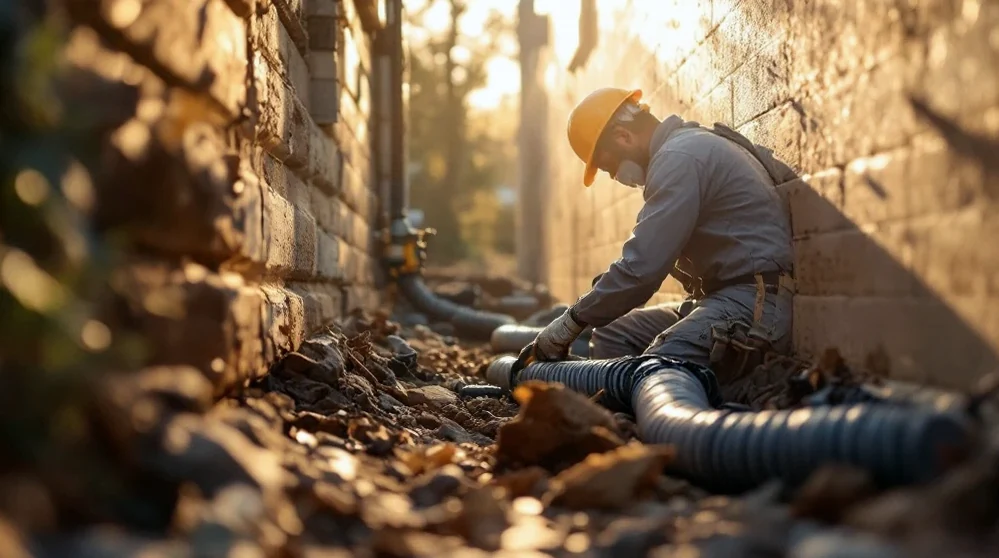
What is Radon Mitigation and how does it work?
Radon mitigation is a system that pulls radon gas from the soil beneath your home and vents it safely above the roofline. The most common setup, active soil depressurization, uses a fan to create suction under the slab, so the gas never enters your living space.
Radon is a radioactive gas that comes from the natural decay of uranium in the ground. It seeps up through the soil and can get pulled into your home through cracks in the foundation, gaps around pipes, or sump pits. Once inside, it can build up to levels that are dangerous to breathe. The EPA and the U.S. Surgeon General recommend fixing any home that tests at or above 4.0 pCi/L. (alabamapublichealth.gov)
The standard fix is called active soil depressurization, or ASD. A contractor drills a hole through your slab floor, digs out a small pit underneath, and inserts a pipe that runs from that pit up through the house to the roofline. A fan installed in that pipe (often in the attic or outside) creates a vacuum under the slab, drawing the radon-laden air out and venting it safely above your roof. The system also seals the hole around the pipe and any other major entry points, so the suction is effective.
For homes with a crawl space, the approach differs. Instead of a slab penetration, the crew lays a heavy plastic membrane over the dirt floor, seals it to the foundation walls, and runs a suction pipe under the membrane. That's called a sub-membrane system, and it's more involved, which is why it costs more. On a slab home, the process is usually straightforward and can be done in a day.
- Active soil depressurization is the most common method for slab and basement homes.
- Crawl space homes use a sealed sub-membrane system.
- Lowering indoor radon levels to below 4.0 pCi/L is the goal, ideally to 2.0 or lower.
Short version
- Radon is a soil gas that can enter your home and reach dangerous levels.
- A mitigation system pulls that gas out from under the house and vents it above the roof.
- Most homes need a simple fan-and-pipe setup, installed in about a day.
- Testing is the only way to know if you need one.
How Radon Mitigation Works, Start to Finish
The process starts with a thorough inspection of your home's foundation, then a hole is cut in the slab, a suction pit is dug, and a pipe with a fan is routed to the roofline. The crew seals all major entry points, and the system is tested to confirm it's pulling properly.
Before we break out the jackhammer, we walk your home to figure out the best route for the pipe. That means checking the foundation type, the location of interior walls, and where the roof line sits. We look for existing cracks, utility penetrations, and sump pits that need sealing. A home with a basement, a slab-on-grade, or a crawl space each get a different approach, and the layout of your house determines how the pipe runs.
For a slab home, the crew cuts a hole in the floor, usually in a closet or utility room, and digs out a small cavity underneath. That cavity gives the fan enough space to pull air from under the entire slab. The pipe goes in, sealed tight to the floor, and runs up through the house, often inside a closet or along an exterior wall, then out through the roof. The fan gets mounted in the attic or on the exterior, and it runs continuously.
Once the system is in, we run a post-mitigation test to confirm radon levels have dropped. That test takes at least 48 hours, and we leave a manometer, a small gauge on the pipe, so you can check the system is working. The gauge shows a vacuum reading; if it drops, you know there's a problem. We also seal any visible cracks in the slab and around pipes, because suction can pull more gas through those gaps if they're left open.
The whole process usually takes a day, sometimes two if the house is large or the route is complicated. The crew handles the permit, which is required in Huntsville and typically runs $25 to $150. (angi.com) You don't need to be home for the installation, but you'll want to be there for the final walkthrough so we can show you how the system works and answer questions.
- Inspect the foundation.We check the slab, crawl space, or basement to find the best suction point and route for the pipe.
- Cut the hole and dig the pit.A 4 to 6 inch hole is cut in the slab, and a small cavity is dug underneath to maximize suction.
- Install the pipe and fan.The pipe runs from the pit to above the roofline, with a fan installed to pull the gas out.
- Seal entry points.Cracks, gaps, and sump pits are sealed so radon can't sneak in through other paths.
- Test and wrap up.A post-mitigation test confirms levels are down, and we show you the manometer and answer questions.
Why Radon Mitigation Matters for Your Home
Radon is the second leading cause of lung cancer in the U.S., and it's a problem in Madison County. The only way to know your exposure is to test, and if levels are high, mitigation is the most effective way to protect your household.
Madison County is one of the 15 Alabama counties the state names as having the highest radon potential, alongside Colbert, Franklin, Jackson, Lauderdale, Lawrence, Limestone and Morgan across north Alabama. (alabamapublichealth.gov) That doesn't mean every home in Huntsville has a problem, but it does mean the geology here is prone to it. The only way to know for sure is to test.
Radon has no smell, no color, and no immediate symptoms. You could live with high levels for years and never notice until health problems show up. That's why the EPA and the Surgeon General recommend testing every home, and fixing any that come in at or above 4.0 pCi/L. (alabamapublichealth.gov) A simple test kit from a hardware store or a professional test can tell you where you stand.
If your home tests high, mitigation is not a luxury. It's a straightforward fix that lowers radon levels dramatically, often to well below the EPA action level. The system runs in the background, using a small amount of electricity, and it's a one-time installation. Compared to the health risk, the cost is modest, and it adds value to your home in the sense that future buyers will see a safe, tested property.
Radon between 2.0 and 4.0 pCi/L
Not an emergency, but consider fixing it, especially if you have young kids or spend a lot of time in the basement. Retest every couple of years.
Radon at or above 4.0 pCi/L
The EPA says fix it. Schedule a mitigation system within a few months, and avoid spending long periods in the lowest level of the home.
Radon above 8.0 pCi/L
High levels like this deserve immediate action. Call a mitigation company this week and limit time in the basement or crawl space until the system is installed.
Common Problems and What Causes Them
Most radon mitigation issues come down to a few recurring problems: a system that wasn't installed right, a fan that's worn out, or a home that has a tricky layout. Here's what to watch for and what typically causes it.
One of the most common issues we see is a system that was installed but never tested afterward. The fan might be running, but if the suction pit is too small or the pipe route is too long, radon levels can stay high. A proper installation includes a post-mitigation test, and any contractor who doesn't do that is leaving you guessing.
Another frequent problem is a radon fan that quits. A fan is a wear item, and you should expect to replace it every 5 to 10 years at roughly $200 to $600, averaging about $350. (angi.com) If the manometer shows no vacuum, the fan has likely failed. Some fans are easier to replace than others; attic and crawl space placements cost more for access. (angi.com)
Crawl space homes have their own set of headaches. The membrane can get punctured by pets, pests, or stored items, which breaks the seal and lets radon back in. If the membrane wasn't sealed to the foundation properly, the system won't pull a good vacuum. We've also seen crawl space systems where the pipe runs through the living space without being properly sealed, which defeats the purpose.
Some homes are just harder to fix than others. A house with a large footprint, a walkout basement, or a sump pit that isn't sealed can require a more complex system. That's when costs climb. A standard active soil depressurization system runs about $800 to $1,500 installed nationally, with complex homes reaching $2,500 or more. (angi.com) In Huntsville, for a standard slab-on-grade home, expect $800 to $1,500 installed. (huntsvilleradonpros.com) Crawl space systems cost more because of the membrane and extra labor, with the membrane alone running $800 to $3,000, and full encapsulation from $1,500 to $15,000 depending on size and access. (bobvila.com)
Worth it when
- Your test shows radon at or above 4.0 pCi/L.
- You're buying or selling a home and the test comes back high.
- You have a crawl space and want to fix radon and moisture at the same time.
Hold off when
- Your test shows radon below 2.0 pCi/L, and you're not planning major renovations.
- You're in the middle of a home sale and the buyer hasn't asked for a fix yet.
- You haven't tested at all. Test first, then decide.
Frequently Asked Questions
How much does radon mitigation cost in Huntsville?
For a standard slab-on-grade home in Huntsville, expect to pay $800 to $1,500 installed. (huntsvilleradonpros.com) Nationally, the average is around $1,000, with most homeowners paying between $800 and $1,300. (angi.com) Crawl space homes cost more, often $1,500 to $15,000 depending on the size and access. (bobvila.com) The only way to get an exact figure is a free on-site quote.
How long does radon mitigation installation take?
Most systems are installed in a single day. A crew will typically arrive in the morning, do the inspection, cut the hole, run the pipe, and seal everything by the afternoon. Larger homes or tricky layouts might take two days, but that's uncommon. The post-mitigation test takes at least 48 hours, so you won't have final results until a couple of days later.
Will radon mitigation lower my home's resale value?
No, it generally helps. A radon mitigation system is a selling point because it means the home has been tested and fixed. Many buyers see it as a plus, especially in Madison County where radon is a known issue. The system is a permanent fixture that requires little maintenance, and it can be a deciding factor for a health-conscious buyer.
Do I need to test for radon after mitigation?
Yes, absolutely. A professional post-mitigation test is the only way to confirm the system is working. We run that test as part of the installation, and we recommend retesting every two years or after any major renovation that could affect the foundation. If you ever see the manometer reading drop to zero, call us to check the fan.
Can I install a radon mitigation system myself?
You could, but it's not a good idea. The system needs to be designed correctly to pull enough suction, and the pipe routing has to be safe and up to code. A poorly installed system can leave radon levels high and waste your money. Professional testing and permits are also part of the job, and a licensed installer knows how to handle tricky foundations.
What is a manometer and why does it matter?
A manometer is a small U-shaped tube filled with liquid that shows the vacuum pressure in the system. It's mounted on the pipe, usually in the basement or garage. If the liquid levels are even, the fan isn't running or there's a blockage. If one side is higher, the system is working. It's your simple way to check that the mitigation system is still doing its job.
Will radon mitigation make my energy bills go up?
Slightly, but not much. The fan runs continuously and uses about as much electricity as a 60-watt light bulb, so expect a small increase in your monthly bill. The system also depressurizes the soil under your slab, which can slightly increase the amount of conditioned air drawn into the ground, but that effect is usually minimal. It's a small price for the health benefit.
What if my radon levels are still high after mitigation?
It happens, but not often. If the post-mitigation test shows levels still above 4.0 pCi/L, the system may need adjustments. Common fixes include adding a second suction point, increasing the fan size, or sealing additional cracks. Our crews will troubleshoot and get it right, often at no extra cost if it's a design flaw.
Do I need to be home during the installation?
Not necessarily, but it helps. If you're not home, we need access to the house and a clear path to the areas where we'll work. We'll need to know where the electrical panel is and any spots you don't want us to walk on. If you're there for the final walkthrough, we can show you the system and answer any questions.
How long does a radon mitigation system last?
The pipe and the sealed penetrations can last decades, but the fan is a wear item. Expect to replace the fan every 5 to 10 years, at a cost of roughly $200 to $600. (angi.com) The rest of the system is low-maintenance, but it's a good idea to check the manometer every few months and clear any snow or debris from the exhaust vent on the roof.
Sources
Need radon mitigation in Huntsville? Get a free estimate today.
📞 256-567-5330